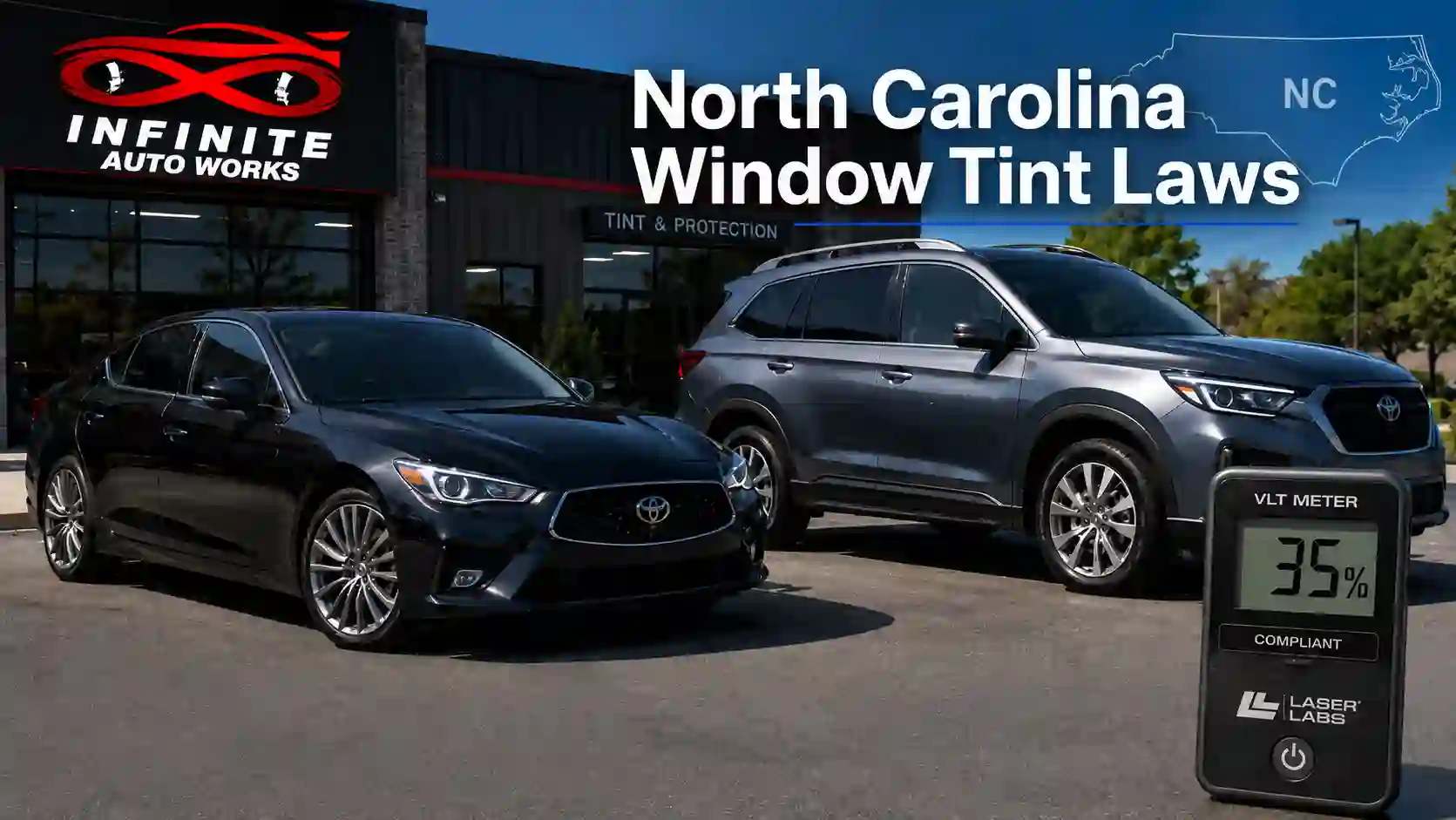
North Carolina window tint laws still control darkness, reflectance, color, and windshield placement in 2026. However, a major enforcement change took effect on December 1, 2025. Infinite Auto Works provides window tinting in Concord, NC for drivers comparing legal shades and heat control. This guide explains the current rules for cars and multipurpose vehicles. It also covers medical permits, inspections, and traffic stops.
What Is the Legal Window Tint in North Carolina?
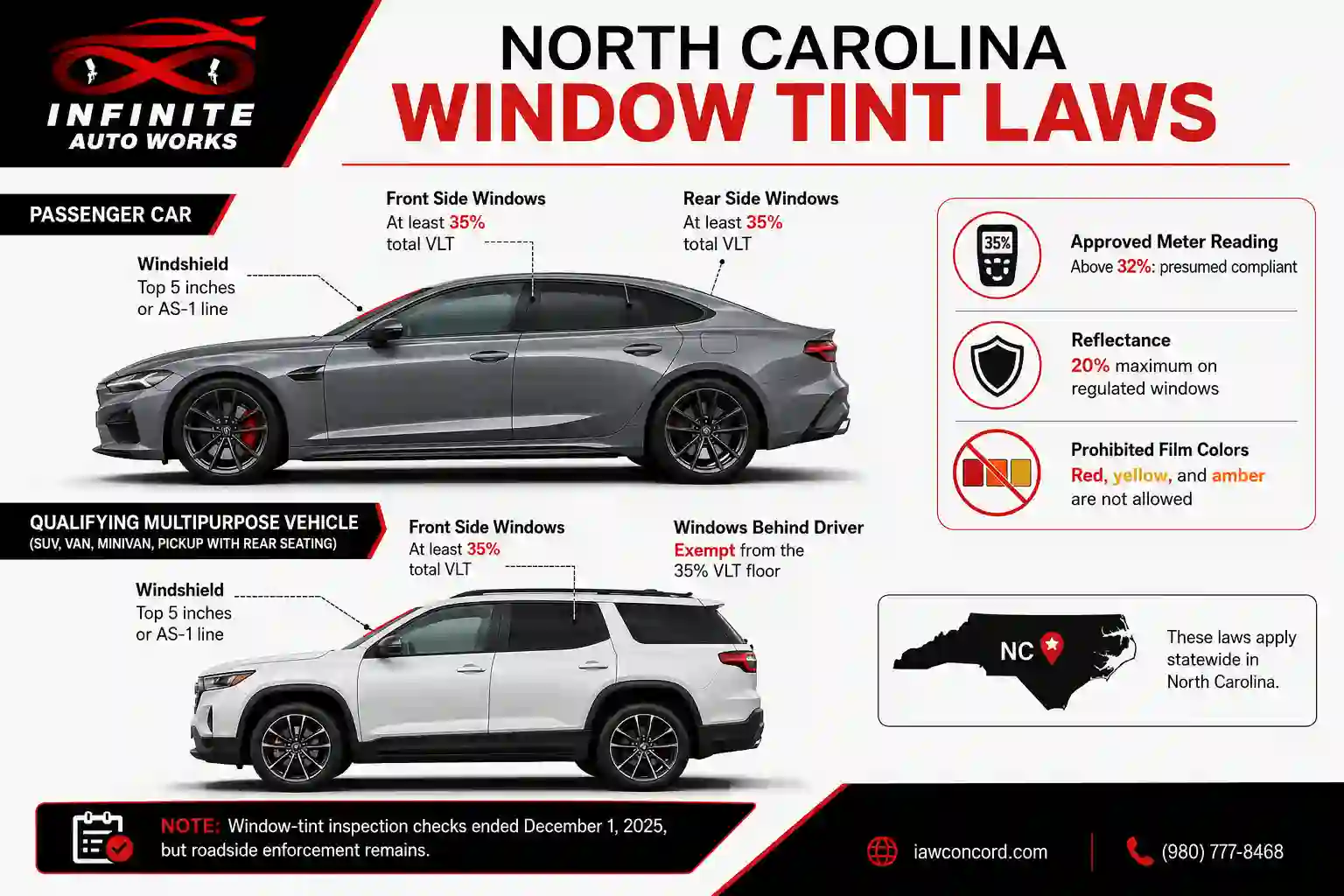
Most non-windshield windows must provide at least 35% total light transmission. A reading above 32% on an approved meter is conclusively presumed to meet that standard. This rule applies to the completed window, including factory glass and installed film.
The windshield follows a different placement rule. Tint may cover only the top strip. The strip cannot extend more than five inches below the top. It may reach the AS-1 line when that line sits lower.
Windows behind the driver on a qualifying multipurpose vehicle are exempt from the 35% VLT floor. They are also exempt from the 20% reflectance cap. The color and nonreflective-film rules still apply.
| Window | Passenger car | Qualifying multipurpose vehicle |
| Windshield | Top five inches or AS-1 line | Same rule |
| Front side windows | At least 35% total VLT | At least 35% total VLT |
| Rear side windows | At least 35% total VLT | No VLT floor when behind the driver |
| Rear window | At least 35% total VLT | No VLT floor when behind the driver |
What Changed in North Carolina’s Tint Law in December 2025?
North Carolina stopped checking window tint during annual safety inspections on December 1, 2025. The separate $10 tint inspection fee also ended. A vehicle should no longer fail its yearly inspection only because of an aftermarket tint reading.
The darkness, windshield, reflectance, and color limits remain. Police can still check installed tint during a traffic stop. A vehicle that breaks the law may receive a citation.
The same change added a roadside duty. A driver must lower the driver-side window when an officer approaches that side. The passenger window must be lowered when the officer approaches from the passenger side.
What Do the 35% VLT and 32% Meter Rules Mean?
VLT means Visible Light Transmission. A higher number allows more visible light through the completed window. A lower number creates darker glass. Drivers can review how 35% window tint looks before comparing physical film samples.
North Carolina sets the legal standard at 35% total light transmission. The law also provides a clear test rule. A reading above 32% on an approved meter is conclusively presumed compliant. This does not make 32%-labeled film a safe choice.
Factory glass already filters some light. Film and glass work together, so you can’t simply add their VLT ratings. Glass transmitting 80% of light with 40% film produces about 32% combined VLT. A professional meter reading provides a safer basis for selecting film.
What Tint Is Legal on Each Vehicle Window?
Front side windows on passenger cars and qualifying multipurpose vehicles follow the 35% total-light rule. A reading above 32% on an approved meter receives the law’s conclusive presumption of compliance.
Rear side and rear windows on standard passenger cars also follow the 35% rule. Qualifying multipurpose vehicles receive a different treatment for windows positioned behind the driver.
Drivers arranging best window tinting in Charlotte, NC should have factory glass checked first. A film label alone does not predict the completed window reading.
Are the Rules Different for Sedans, SUVs, Vans and Trucks?
North Carolina law separates standard passenger cars from multipurpose vehicles. A qualifying multipurpose vehicle carries ten or fewer people. It is built on a truck chassis or has features for occasional off-road use. The statute specifically includes minivans and pickup trucks.
Windows behind the driver on a qualifying multipurpose vehicle are exempt from the 35% VLT and 20% reflectance limits. Front side windows still follow the standard rule. The windshield also keeps the same top-strip restriction.
A retail label such as crossover or SUV does not settle the legal class. Infinite Auto Works can review the vehicle type and existing rear privacy glass. Confirm final questions about vehicle class with the proper state agency.
Can a Windshield Be Tinted in North Carolina?
North Carolina permits dark tint only along the top of the windshield. It can extend five inches below the top. It may instead reach the maker’s AS-1 line when that line sits lower.
The statute also permits untinted clear film across the windshield. It must not block the driver’s view. It must reduce or remove ultraviolet radiation without adding visible darkness.
Medical permits do not remove the windshield placement rule. The statute says its windshield rules apply without exception. A full-windshield product must be truly clear and must not block the driver’s view.
What Reflectivity and Tint Colors Are Prohibited?
Tinted windows subject to the standard rules must have light reflectance of 20% or less. The film must also be nonreflective. A listed reflectance figure does not make a mirrored finish legal.
Red, yellow, and amber tinting materials are prohibited. Neutral carbon and ceramic films must still meet the installed VLT rule on each regulated window.
Owners should compare the exact product details instead of relying on a sample photo. Lighting and cabin color can change how a shade looks online. Glass type and camera exposure can, too.
Is Window Tint Still Checked During North Carolina Inspections?
No. North Carolina removed window-tint checks from safety inspections effective December 1, 2025. Inspection stations also stopped collecting the separate $10 tint-testing fee.
This change affects the inspection process, not the tint limits. A car can pass its yearly safety inspection without a tint test. Unlawful tint can still lead to a roadside citation.
Older articles, shop pages, and inspection manuals may still describe the former testing process. Drivers should check the publication date before relying on those instructions.
What Must Drivers Do During a Traffic Stop?
Drivers of vehicles with tinted windows must lower the driver-side window when an officer approaches. If the officer approaches from the passenger side, the driver must lower the passenger window.
The rule applies because the vehicle has tinted windows. It is not limited to tint that looks too dark. A failed meter test is not required first.
Drivers should keep the vehicle stopped safely and follow lawful directions. A medical permit should remain inside the vehicle to which it applies.
What Are the Penalties for Illegal Window Tint?
Applying unlawful tint to a covered vehicle is a Class 3 misdemeanor. Driving that vehicle on a highway or public vehicular area is also covered. Court costs and outcomes vary by case, so there is no single ticket total.
North Carolina provides a defense for drivers who remove unlawful tint within 15 days of the charge. The driver must then obtain a compliance certificate. It must come from the Division of Motor Vehicles or Highway Patrol and go to the court or prosecutor.
That correction defense is not the same as automatic dismissal. A driver facing a charge should follow the official process and seek qualified legal guidance when needed.
How Does the Medical Tint Exemption Work?
A person with a condition that causes visible-light sensitivity may apply to the Driver’s Medical Evaluation Program using the official Tinted Window Waiver Application. The applicant must submit a written application. A doctor must also complete the state medical form.
An approved permit usually lasts five years, unless the program sets a shorter term. Renewal requires new medical approval. One person may hold no more than four valid permits at once.
The permit identifies the approved vehicle, windows, and tint levels. It must stay in that vehicle while it is driven. The state also provides a sticker for the lower-left corner of the rear window. Failure to display that sticker is an infraction carrying a $200 fine.
Which Vehicles and Windows Have Other Exceptions?
The statute lists several exceptions to the 35% VLT and 20% reflectance rules. They include qualifying windows on motor homes, ambulances, limousines, law-enforcement vehicles, and excursion passenger vehicles.
Other exceptions cover the rear window of a vehicle used to haul property. They also cover windows behind the driver on a qualifying multipurpose vehicle. An out-of-state vehicle can qualify when it meets the tint law of its registration state.
These exceptions do not erase the windshield restrictions. Commercial vehicles covered by federal rules may also follow a separate standard. Confirm unusual vehicle classifications before installing film.
How Is Installed Window Tint Measured?
North Carolina evaluates total light transmission through the completed window. That means the meter measures the combined effect of factory glass and aftermarket film.
The conclusive presumption applies to readings above 32% from a meter approved by the Commissioner. A consumer device can offer an informal check. It does not carry the same legal status.
Infinite Auto Works can meter existing glass before film selection. Drivers comparing installers can also read about choosing a window tint shop in Concord. The guide covers film details, measurement, written quotes, and aftercare.
How Can Drivers Choose Legal Tint With Strong Heat Rejection?
Tint darkness and heat rejection are not the same measurement. VLT describes visible light. Infrared and total solar-energy figures describe different parts of film performance.
A light ceramic film can reject heat while keeping the completed window above the legal darkness floor. Performance varies by product. Drivers should compare verified data for the exact film series.
The safest selection process starts with a factory-glass measurement. The installer can then compare film samples and estimate the combined VLT. A final meter check confirms the installed result.
Where Can Drivers Verify the Official North Carolina Rules?
The current North Carolina General Statute §20-127 controls the state’s window-tint rules. It covers exceptions, penalties, medical permits, and the traffic-stop requirement.
Regulations and official procedures can change after an article is published. Drivers should use the statute and current NCDMV guidance to confirm details. This guide provides general information and is not legal advice.
Conclusion
North Carolina still requires at least 35% total light transmission on regulated non-windshield windows. A reading above 32% on an approved meter is conclusively presumed compliant. The result also depends on vehicle class and window position. Windshield placement, reflectance, film color, and medical permits matter too.
Infinite Auto Works helps Concord-area drivers compare film performance with current state rules. Our guide to the best tint percentage for daily driving explains visibility, privacy, appearance, and heat control. Review those factors after checking the legal limits.
Frequently Asked Questions
What is the darkest legal window tint in North Carolina?
North Carolina generally requires at least 35% total light transmission on regulated side and rear windows. A reading above 32% on an approved meter is conclusively presumed compliant. State law exempts windows behind the driver in qualifying multipurpose vehicles.
Is 20% window tint legal in North Carolina?
Twenty-percent tint is generally too dark for regulated windows because North Carolina requires at least 35% total light transmission. It may be permitted behind the driver on a qualifying multipurpose vehicle or on another exempt window. Front side windows still follow the standard rule.
Does North Carolina still inspect window tint?
North Carolina removed window-tint checks from annual safety inspections on December 1, 2025. The separate $10 tint-testing fee also ended. Legal VLT, windshield, color, and reflectance limits still apply. Police may enforce them during traffic stops and other roadside checks in 2026.
Can SUVs and trucks have dark rear window tint in North Carolina?
Windows behind the driver on a qualifying multipurpose vehicle are exempt from the 35% VLT and 20% reflectance limits. State law includes minivans and pickup trucks. An SUV must meet the legal vehicle definition, while its front side windows remain regulated under current state law.
Can the full windshield be tinted in North Carolina?
Dark tint is limited to the windshield’s top five inches or the AS-1 line when that line sits lower. Untinted clear UV film may cover more glass as long as it does not block the driver’s view. Medical permits do not remove this placement rule for every vehicle under North Carolina law.
How does a North Carolina medical tint permit work?
A person with visible-light sensitivity may apply through the Driver’s Medical Evaluation Program with a doctor-completed state form. The permit applies to a listed vehicle, usually lasts five years, and must be used only in that vehicle. In 2026, an approved rear-window sticker is also required.