


How many hours a week do you spend in your car? Whether it’s a daily commute, school runs, or weekend adventures, your vehicle is more than just transportation. But have you ever considered it a potential health hazard? Many people are unaware that prolonged exposure to ultraviolet (UV) radiation while driving poses a significant, yet often overlooked, risk to our health. The good news is that there’s a powerful, scientifically-backed solution already available. Professional window tinting, particularly the services offered by experts like Infinite Auto Works, serves as a critical shield, dramatically reducing these health risks and turning your daily drive into a safer, more protected environment.
Your Car: An Unexpected Sun Exposure Zone
We slather on sunscreen at the beach and wear hats for garden work, yet we often remain unaware of the invisible assault taking place during our daily drives. The fact is, glass does not provide complete protection from the sun’s harmful rays. While your windshield is typically laminated and offers some inherent UV protection, the side and rear windows are usually made from tempered glass, which does a poor job of filtering out UVA rays. This means that during your daily drive, you are sitting in a zone of continuous, low-level UV exposure. This cumulative exposure, day after day, year after year, can have serious consequences for your skin and eye health.
Understanding the Invisible Threat: UVA vs. UVB Rays
To understand the solution, we must first understand the problem. Sunlight contains two types of ultraviolet radiation that concern us: UVA and UVB. They affect our skin in profoundly different ways.
UVB Rays: The Surface Burners
UVB rays have a shorter wavelength and are primarily responsible for what we all recognize: sunburn. They play a key role in the development of skin cancer. Thankfully, most auto glass does a decent job of blocking the majority of UVB rays. You’re unlikely to get a classic sunburn through your car window.
UVA Rays: The Deep Penetrators
UVA rays are the stealthy, silent threat. They have a longer wavelength, allowing them to penetrate deep into the skin’s thickest layer (the dermis). They are the primary culprits behind skin aging—think wrinkles, leathery texture, and sunspots. More critically, they are a known contributor to skin cancer, including melanoma, the most dangerous form. Unlike UVB rays, UVA rays can pass effortlessly through glass.
The Automobile Glass Loophole
Here’s the critical loophole: while your car’s windshield is made from laminated glass that blocks about 96-99% of UV radiation, the side and rear windows are typically tempered glass. Tempered glass, on its own, might only block 20-30% of UVA rays. This leaves you and your passengers highly exposed to these penetrating rays during every journey.
The Direct Health Implications of Unfiltered UV Exposure
The consistent UVA exposure you receive while driving isn’t just a theoretical risk; it translates into several tangible health concerns.
The Risk of Skin Cancer on the Road
Studies in the Journal of the American Academy of Dermatology have shown a fascinating and alarming pattern. They found a higher incidence of skin cancers on the left side of the body—the side most exposed to the sun while driving in countries with left-hand drive vehicles, like the United States. This includes the left arm, left side of the face, and left ear.
Left-Side Driving Asymmetry: A Startling Fact
This phenomenon, sometimes called “commuter cancer,” provides compelling real-world evidence of the risks of driving without protection. The asymmetry of sun damage clearly points to vehicle window exposure as a significant contributing factor to skin cancer development over a lifetime.
Photoaging: Premature Aging Caused by the Sun
If the cancer risk isn’t enough to convince you, consider the cosmetic impact. Photoaging refers to the premature aging of the skin caused by repeated exposure to UV radiation. It’s responsible for up to 90% of the visible changes commonly attributed to aging. Your daily commute is actively contributing to this process on the left side of your face and body.
Ocular Damage: Protecting Your Eyesight
Your eyes are also vulnerable. Prolonged UV exposure can increase the risk of several serious eye conditions, including cataracts, macular degeneration, and photokeratitis. While sunglasses are essential, they don’t protect your entire eye socket or the skin around your eyes from reflected UV light inside the car.
How Window Tinting Creates a Barrier
This is where the powerful, preventative science of window tinting Concord NC comes into play. High-quality window film acts as a sophisticated optical filter applied directly to your glass.
The Mechanism of UV Blockage
Films work through two primary physical principles to block harmful radiation:
Absorption: The Molecular Sponge
Some films, particularly dyed ones, contain particles that absorb UV radiation. The energy is converted into insignificant amounts of heat, which is then dissipated. The film itself acts like a sacrificial sponge, soaking up the harmful rays so they don’t reach you.
Reflection: The Deflective Shield
Higher-performance films, such as those embedded with ceramic or carbon particles, work primarily by reflection. These microscopic particles create a permanent, invisible shield that reflects UVA and UVB radiation away from the window.
Understanding SPF and UPF in the Context of Your Car
We’re familiar with SPF (Sun Protection Factor) in sunscreen. In the world of fabrics and films, we use UPF (Ultraviolet Protection Factor). A high-quality window tinting film from a provider like Infinite Auto Works can achieve a UPF of 50+. This means it blocks over 98% of all UV radiation.
Beyond Skin Deep: Additional Health and Comfort Benefits
The health benefits of window tinting extend beyond blocking UV rays.
Reducing Glare and Eye Fatigue
Glare from the sun or other vehicles’ headlights is a major cause of eye strain and driver fatigue. By filtering the intensity of incoming light, tint dramatically reduces this glare, making for a more relaxed, visually comfortable, and ultimately safer driving experience.
Mitigating Interior Heat and Improving Air Quality
By rejecting a significant portion of solar infrared radiation, window tinting keeps your car’s interior cooler. This reduces the need to constantly run the air conditioning at maximum power. Furthermore, by reducing the heat and UV exposure on your dashboard, you minimize the “off-gassing” of chemicals from plastics and vinyl.
Choosing the Right Protection: What to Look For in Window Tinting
Not all tint is created equal. To maximize your health protection, you need to be an informed consumer.
The Critical Importance of UV Rejection Rates
The single most important number to ask about is the film’s UV rejection rate. For true health protection, you should not settle for anything less than 99%. Reputable manufacturers and installers like Infinite Auto Works will be transparent about this specification.
Material Matters: Dyed, Hybrid, Ceramic, and Carbon Films
There are several types of window films available, each offering different levels of protection. Dyed films are entry-level, mainly reducing glare and enhancing appearance but prone to fading over time. Carbon films block UV rays and infrared heat effectively without fading or interfering with signals. Ceramic films deliver the highest performance, rejecting intense heat and UV while maintaining clear visibility and long-term durability.
Why Ceramic Tint is the Health-Conscious Choice
Ceramic tint is considered the most health-focused option because it blocks up to 99% of harmful UV rays and a significant portion of infrared heat, which are both linked to skin damage, premature aging, and eye strain.
Unlike older metallic films, ceramic tint doesn’t interfere with GPS or phone signals and maintains crystal-clear visibility, keeping both your health and driving safety protected.
The Non-Negotiable Value of Professional Installation
The best film in the world is only as good as its installation. Professional application by certified window tint installers, like those at Infinite Auto Works, is crucial for ensuring optimal performance and protection.
Navigate from Centerview to Infinite Auto Works Now
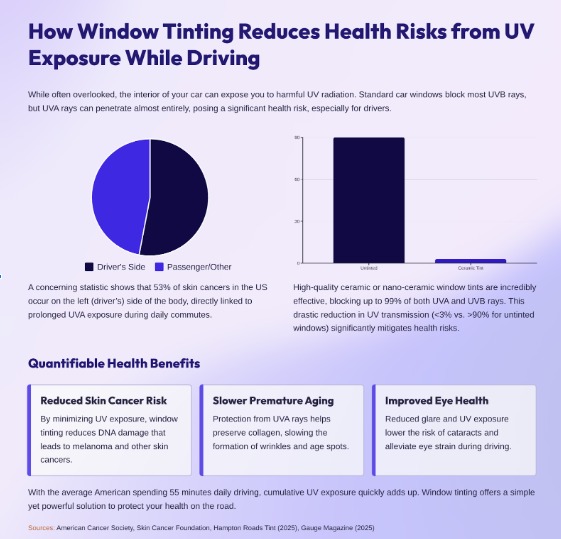
How Window Tinting Reduces Health Risks from UV Exposure
- UV Exposure in Cars: A Hidden Danger
- Standard car windows block most UVB but allow up to 95% of UVA rays to penetrate.
- UVA rays cause 53% of skin cancers on the left (driver’s) side of the body in the US.
- The average American spends 55 minutes daily driving, accumulating significant UV exposure.
- Window Tinting Effectiveness
- High-quality ceramic or nano-ceramic tint block up to 99% of UVA and UVB rays.
- Tinting reduces cumulative UV exposure, lowering risks of melanoma and premature skin aging.
- Compared to untinted windows, tinting cuts UV transmission by over 90%.
- Health Benefits Quantified
- Skin cancer: UV protection from tinting reduces DNA damage linked to melanoma.
- Premature aging: Collagen breakdown slowed, reducing wrinkles and age spots.
- Eye health: Reduced glare lowers risk of cataracts and eye strain.
- Visual Chart Concepts:
- Bar chart comparing % UV transmission: Untinted windows (50-95% UVA passes) vs. Ceramic tint (1-5% UVA passes).
- Pie chart showing distribution of skin cancers by body side, highlighting 53% on driver’s side.
- Line graph illustrating cumulative UV exposure over daily driving time with and without tint.
Sources: American Cancer Society, Skin Cancer Foundation, Hampton Roads Tint (2025), Gauge Magazine (2025)
Frequently Asked Questions
Can I still get vitamin D if my car windows are tinted?
Yes. The body primarily synthesizes vitamin D from UVB rays, which are largely blocked by glass anyway. You should not rely on driving for your vitamin D needs.
Does window tinting protect me even on cloudy days?
Absolutely. Up to 80% of UV radiation can penetrate clouds. Since high-quality window tinting blocks UV rays regardless of cloud cover, it provides protection 365 days a year.
How does window tinting protect against skin cancer compared to sunscreen?
Window tinting provides a passive, constant form of protection that doesn’t wear off, sweat off, or need reapplication. While sunscreen is essential for direct sun exposure, it is impractical for daily driving.
Is there a clear window tint that still blocks UV rays?
Yes. UV protection is not dependent on darkness. High-performance ceramic and carbon films are available in very light shades that are nearly clear yet still block 99% or more of UV radiation.
Can existing sun damage be reversed by getting window tinting?
While window tinting cannot reverse existing damage like wrinkles or sun spots, it will prevent further UV-related damage from occurring during your drives. This halts the progression of photoaging and reduces your future risk of skin cancer.
Our Other Blog Posts Related Window Tinting
How Window Tinting Boosts Energy Efficiency in Modern Vehicles